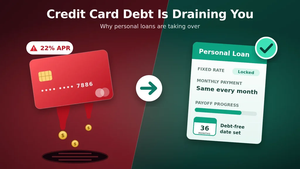
5 Ways to Cut Credit Card Interest Without Earning More
More of your payment should go to your balance, not the bank. (Image: Magnific)
Updated November 2026
In plain terms: You can pay less credit card interest without making more money.
Here’s how: (1) pay more than the minimum and pay earlier, (2) pay new purchases in full so you don’t get charged interest, (3) ask your card company for a lower rate, (4) move your balance to a 0% intro APR card and (5) combine your debt into a cheaper loan or a nonprofit debt plan.
Small moves can save you hundreds of dollars.
Feel like your payments mostly go to interest?
You can change that without a raise. It’s about paying smarter and finding a cheaper rate. Here are five simple ways to do it.

Why is credit card interest so high?
Card rates are high, and interest is added every day on what you owe.
The average APR on credit card accounts charged interest was 22.15% in the second quarter of 2026, according to the Federal Reserve.
That means a $4,000 balance can cost about $73 in interest in just one month. Here’s how APR works.
How much can you save?
For a $4,000 balance at 22% APR:
How much could you save?
Compare the cost of different ways to pay down your balance.
| What you do | Before | After | You save about |
|---|---|---|---|
| Pay $200 a month instead of $120 | ~$2,240 interest ~52 months |
~$1,030 interest ~26 months |
$1,210 and 2 years |
| Get your APR lowered to 17% Paying $120 a month | ~$2,240 interest | ~$1,450 interest | $790 |
| 0% balance transfer for 15 months 3% fee, compared with 22% APR and $280 monthly payments | ~$680 interest | $120 fee | $560 |
These figures are estimates. Your actual savings depend on your balance, interest rate, fees and payment schedule.
Estimates assume the same payment each month, no new purchases and monthly interest. Your card’s terms may change the results.
1. Pay more and pay sooner
Extra money goes straight to your balance, so you pay less interest next month. Minimum payments keep you in debt for years.
Here’s why your minimum payment covers less debt.
Two easy tricks:
- Pay twice a month. It can lower your average balance and your interest.
- Pay before your statement closes. It can also help your credit score.
If you have balances with different rates on one card, anything above the minimum goes to the highest rate first. That’s the law under the CARD Act.
2. Use your grace period
Pay your full statement balance by the due date, and you won’t pay interest on new purchases. That’s called the grace period.
Your statement has to arrive at least 21 days before the due date.
If you carry a balance, you usually lose this break, and new purchases get charged interest right away. So while you pay off a card, stop using it. Use debit or cash instead.
3. Ask for a lower rate
Call your card company and ask. It’s free, and it often works. Here’s how:
- Know your APR, balance and how long you’ve had the card.
- Mention that you pay on time.
- Mention lower offers you’ve gotten in the mail.
- Ask: “Can you lower my interest rate?”
- Struggling? Ask about hardship programs. Some companies lower rates for a while.
If they say no, try again in a few months.
4. Move your balance to a 0% card
A balance transfer moves your debt to a new card with a 0% or low starting rate. That way, more of your payment lowers what you owe. By law, these intro rates must last at least six months.
Check these first:
- The transfer fee, usually 3% to 5% of what you move.
- How long the 0% lasts, and whether you can pay it off in time.
- The rate after the intro period.
- 0% APR or “deferred interest”? With deferred interest, if you don’t pay it all off in time, you can owe all the interest from the start, according to the CFPB.
Read about balance transfer traps before you apply.
5. Combine your debt or get nonprofit help
A personal loan with a lower fixed rate can replace several card balances with one payment and a clear end date. Compare offers with prequalification, which doesn’t hurt your score. Here’s how to find low-interest personal loans.
Can’t get a good loan rate? Try a nonprofit credit counseling agency.
Many offer debt management plans. They ask your card
companies for lower rates, and you make one payment a month to the agency. Pick an accredited nonprofit, and stay away from companies asking for big fees upfront.
What should you avoid?
- Cash advances. Higher rates and interest from day one.
- Late payments. Fees and possibly a penalty APR, which can apply to your existing balance if you’re more than 60 days late.
- New charges on the card you’re paying off.
- Running up the old card after a transfer.
Which way should you start with?
Find the right strategy for your situation
Start with the approach that best matches your financial situation.
You can mix them. Ask for a lower rate first, then pay a bit more each month.
Your checklist
Check off each step as you make progress toward managing your credit card debt.
Frequently asked questions
Pay more than the minimum and move your balance to a 0% intro APR card.
Many will, especially if you pay on time. It’s worth asking.
Applying adds a hard inquiry, which usually lowers your score a little for a short time. Paying down debt can help your score later.
No. A debt management plan helps you pay everything back at lower rates. Debt settlement tries to pay less than you owe and can hurt your credit a lot.
It can, by keeping your average daily balance lower.
Try this 30-day plan to get your finances in order.
Keep more of what you earn
You don’t need a bigger paycheck to pay less interest. Small, smart moves add up, and you’ll see your balance drop faster.
👉 Next step: See how the Wells Fargo Reflect Card works