
Why your minimum payment now covers less debt
Discover why your minimum payment reduces less credit card debt, how interest affects your balance, and what you can do to pay it off faster.
Warning: your minimum payment may be trapping you in debt
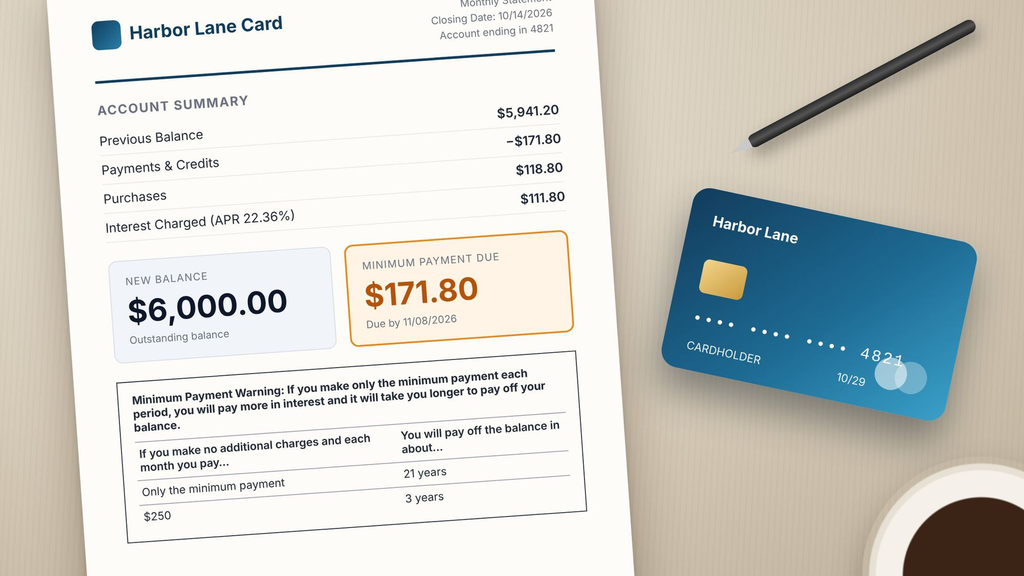
You pay your credit card bill every month. So why does your balance barely change?
The answer may be your minimum payment. When interest rates are high, much of your payment can go toward interest instead of reducing your debt.
New purchases and fees can make the problem even worse.
In August 2026, the average annual interest rate on U.S. credit card accounts assessed interest was 22.36%, according to the Federal Reserve.
Meanwhile, Americans had approximately $1.263 trillion in credit card debt in the second quarter of 2026.
Understanding how your minimum payment works can help you reduce interest costs and make real progress toward becoming debt-free.
Why Your Minimum Payment Covers Less Debt
Your minimum payment is the smallest amount your credit card issuer requires you to pay by the due date to keep your account current.
But there’s a catch: paying the minimum doesn’t mean you’re making significant progress toward eliminating your debt.
The Consumer Financial Protection Bureau (CFPB) warns that paying only the minimum generally means paying more interest and taking longer to repay your balance.
Three factors can make your debt harder to pay off.
1. High Interest Rates Eat Into Your Payment
When you carry a credit card balance, interest adds to the cost of your debt.
The higher your APR (annual percentage rate), the more interest you may owe.
Consider this example:
- Credit card balance: $5,000
- APR: 22.36%
- Estimated monthly interest: $93.17
- Hypothetical minimum payment: $100
- Amount reducing principal: just $6.83
This is a simplified illustration, not a universal minimum-payment formula. Actual interest depends on your daily balance, billing cycle, and account terms.
Still, the takeaway is clear: high interest rates can leave very little of your payment available to reduce your debt.
2. Your Minimum Payment Can Change
Credit card issuers use different formulas to calculate minimum payments.
Depending on your agreement, your minimum may be based on a percentage of your balance, a fixed amount, interest and fees, or a combination of these factors.
As your balance falls, your minimum payment may also decrease.
That can make your bill easier to manage, but it may slow your progress if you keep paying only the new minimum.
Tip: If your budget allows, consider maintaining a higher monthly payment even when your required minimum decreases.
3. New Purchases Can Cancel Out Your Progress
Making payments doesn’t guarantee your balance will fall quickly.
Imagine you:
- Pay $200 toward your card.
- Add $150 in new purchases.
- Incur $40 in interest and fees.
Your balance decreases by only $10, assuming no other transactions or adjustments.
That’s why you should track more than your monthly payment. Check your balance, interest charges, fees, and new purchases together.
What Happens If You Pay Only the Minimum?
Paying the minimum can help keep your account current. But relying on it month after month can make debt more expensive.
Here are three potential consequences.
You Pay More Interest
The longer you carry a balance, the more interest you may accumulate.
Depending on your APR and payment habits, interest can become a substantial part of your total repayment cost.
Your Debt Takes Longer to Pay Off
When interest consumes much of your payment, your principal decreases slowly.
If you continue making new purchases, getting out of debt can become even harder.
You Have Less Money for Other Goals
Money spent on interest can’t be used for other priorities, such as:
- Rent and groceries
- Emergency savings
- Retirement contributions
- Other outstanding bills
If money is tight, paying the minimum may be your only realistic option for now. The important thing is to understand the cost and work toward a sustainable repayment plan.
How to Make Your Minimum Payment Reduce More Debt
You don’t need to overhaul your finances overnight.
Start with a few practical steps.
Pay More Than the Minimum When Possible
If your minimum payment is $100 and you can comfortably afford $150, the extra $50 can help reduce your principal faster.
Lowering your principal can also reduce future interest costs.
However, don’t stretch your budget so far that you need to borrow again to cover essential expenses.
Choose a payment amount you can sustain every month.
Review Your APR and Credit Card Statement
Your monthly statement can help you understand why your balance isn’t falling.
Check these details:
- Your current APR
- The interest charged
- Your minimum payment
- Your payment due date
- Your outstanding balance
Then ask yourself:
Is my balance actually decreasing?
Compare your balance from one month to the next. If it barely changes, review your interest charges and recent purchases.
Ask Your Issuer About a Lower APR
If interest makes repayment difficult, contact your credit card issuer.
Ask whether you qualify for:
- A lower interest rate
- A hardship program
- An alternative payment arrangement
Approval isn’t guaranteed, but asking may help you identify a more manageable option.
You can also compare balance transfer cards or debt consolidation loans.
Before accepting an offer, check transfer fees, promotional expiration dates, and the regular APR after the introductory period.
A lower advertised rate doesn’t automatically mean a cheaper solution.
Check Your Repayment Estimate
Applicable credit card statements include disclosures about the time and cost of paying only the minimum.
Your statement may also show an estimated monthly payment that would repay your balance within 36 months.
Review that estimate and compare it with your budget.
If the suggested payment is too high, choose a realistic amount and reassess your plan as your finances change.
Why October Is a Good Time to Review Your Credit Card Debt
October is National Financial Planning Month in the United States.
It’s a timely reminder to review your spending, outstanding balances, and financial goals before the end of the year.
October 15, 2026, also marked the American Bankers Association Foundation’s annual Get Smart About Credit Day, which promotes credit education.
With holiday shopping and travel approaching, a little planning can help you avoid unnecessary credit card debt.
Use October to take five steps:
- List your balances and APRs. Identify your most expensive debts;
- Review your interest charges. See how much of each payment reduces your principal;
- Set a realistic payment target. Protect your budget for essential expenses;
- Plan holiday spending. Decide what you can afford before shopping;
- Track your progress. Compare your balance every month.
You don’t have to eliminate your debt before the end of the year. The goal is to finish the year with a clearer plan.
When to Seek Help With Credit Card Debt
If your balance keeps growing or you can no longer afford your minimum payment, don’t ignore the problem.
The CFPB recommends contacting your credit card company promptly if you’re having trouble paying your bill.
Ask about hardship options, reduced interest rates, or alternative payment arrangements.
You can also consider a reputable nonprofit credit counseling agency.
Be cautious of companies that:
- Guarantee they can eliminate your debt.
- Demand substantial upfront fees.
- Tell you to stop communicating with your card issuer.
These can be warning signs of risky debt relief services.
If you’re struggling to cover essentials, prioritize basic needs and seek qualified guidance before committing to a repayment plan.
Author’s Opinion
Credit card debt can be frustrating because you may feel like you’re doing everything right.
You pay your bill every month, yet your balance barely moves.
The problem is that your minimum payment is designed to meet a payment requirement, not necessarily to get you out of debt quickly.
When interest rates are high, the difference between paying the minimum and paying a little more can matter.
But that doesn’t mean you should sacrifice essential expenses to pay off debt faster.
Start by reviewing your APR, understanding your statement, and identifying one realistic change.
You might pay a little extra, avoid new purchases on a card carrying a balance, or ask your issuer about a lower rate.
You don’t have to eliminate your debt overnight. You need to understand why your minimum payment covers so little debt and build a realistic plan to change that.
Recommended Content
2027 social security raise
Learn when payments change, how much you may receive, and how Medicare costs affect your budget.
Continue Reading * You will remain on the current website