
Loan rates: the September 30 deadline you can’t miss
Find out how the September 30 deadline can lower interest rates on eligible federal student loans through automatic payments.
Loan Rate Too High? What to Do Before September 30
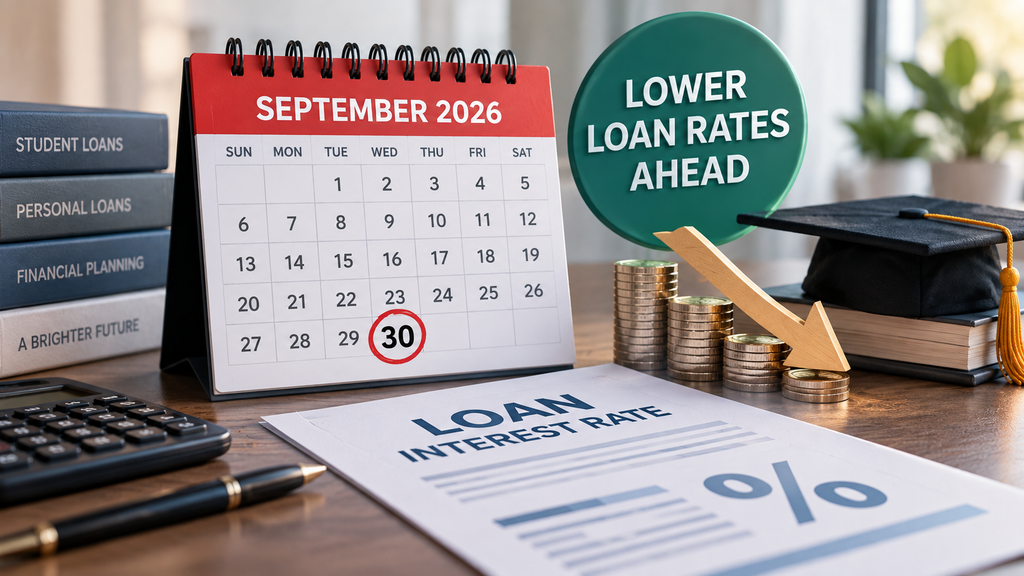
September 30, 2026, is an important deadline for eligible federal student loan borrowers.
If you enroll in automatic payments by 11:59 p.m. on that date, you may qualify for a temporary 1-percentage-point reduction in your loan interest rate through June 30, 2028, according to the U.S. Department of Education.
This deadline does not apply to every type of loan. It is specifically connected to eligible federal student loans and the Auto Pay interest-rate reduction.
If you’re trying to lower your borrowing costs, here’s what the September 30 deadline means, who qualifies, how the reduction works and what you should check before the deadline.
What Is the September 30 Loan Interest Rate Deadline?
The September 30 deadline is the cutoff for eligible federal student loan borrowers to enroll in Auto Pay and receive the temporary 1 percentage-point interest-rate reduction.
The U.S. Department of Education increased the Auto Pay interest-rate reduction from 0.25 percentage points to 1 percentage point beginning July 1, 2026.
Eligible borrowers who enroll by September 30 can receive the temporary reduction through June 30, 2028.
Why Does the September 30 Deadline Matter?
A lower loan interest rate can reduce the amount of interest that accrues on an outstanding student loan balance.
The potential impact depends on your balance, repayment schedule and remaining loan term.
For example, a borrower with a $30,000 balance would have a simple annual interest difference of approximately $300 between a 7% and 6% rate before accounting for principal payments.
That is an illustration, not a prediction of an individual’s actual savings.
Is September 30 a Deadline for All Loans?
No.This is one of the most important distinctions to understand.
The September 30 deadline does not mean that personal loans, mortgages, auto loans or private student loans must be refinanced before that date.
The temporary 1-point reduction is associated with eligible federal student loans and Auto Pay.
Who Qualifies for the 1% Loan Interest Rate Reduction?
Eligible federal student loan borrowers who enroll in Auto Pay by September 30, 2026, can qualify for the temporary 1 percentage-point reduction.
The Department of Education says the enhanced reduction applies to eligible Direct Loans disbursed on or after July 1, 2012.
Your individual eligibility should be confirmed through your loan servicer.
What If You Already Have Auto Pay?
If you’re already enrolled in Auto Pay, you generally do not need to enroll again.
The new structure increases the total Auto Pay reduction to 1 percentage point, meaning borrowers previously receiving the 0.25% reduction can receive an additional 0.75 percentage-point reduction.
Check your servicer account to confirm how the discount appears on your specific loans.
Why Loan Interest Rates Matter for Borrowers in 2026
Borrowing costs remain an important household-finance issue in the United States.
The Federal Reserve raised the federal funds target range by 0.25 percentage point on September 16, 2026, to 3.75%–4%.
Separately, the Federal Reserve Bank of New York reported that total U.S. household debt reached $18.8 trillion in Q2 2026.
These figures do not determine the rate offered to an individual borrower. Different loans use different pricing mechanisms.
But they show why consumers continue to pay attention to borrowing costs.
What Does the Federal Funds Rate Have to Do With My Loan?
The federal funds rate is not the interest rate on your personal loan or student loan.
Instead, it is the rate at which banks lend reserve balances to one another overnight.
Changes in monetary policy can influence broader financial conditions, but the effect on an individual loan depends on the type of credit and how its rate is determined.
This distinction is especially important when reading headlines about “falling” or “rising” loan rates.
Loan Interest Rate vs. APR: What’s the Difference?
An interest rate is the percentage charged on borrowed money, while APR generally provides a broader measure of the annual cost of a loan, including certain fees.
For consumers comparing personal loans, APR can be particularly useful because two loans with the same advertised interest rate may have different fees.
Why This Matters When Comparing Personal Loans
NerdWallet reported that personal-loan APRs can range from roughly 6% to 36%, depending on the lender and borrower.
Its September 2026 data also showed significant differences in average prequalified APRs across credit profiles.
That means the rate another borrower receives is not necessarily the rate you’ll receive.
How to Check Your Loan Interest Rate Before September 30
The fastest way to determine whether the deadline matters to you is to check your federal student loan account and Auto Pay status.
Follow these steps:
Step 1: Check Your Current Loan Interest Rate
Log in to your federal student loan servicer account.
Record the current rate for each loan.
Step 2: Check Auto Pay
Look for the payment settings section and verify whether Auto Pay is active.
If you aren’t enrolled, review the enrollment instructions provided by your servicer.
Step 3: Verify the Rate Reduction
Look for information showing whether the Auto Pay reduction applies to your loan.
If you cannot find the information, contact the servicer.
Step 4: Confirm Your Bank Account
Make sure the bank account connected to Auto Pay is active and has sufficient funds for scheduled withdrawals.
Step 5: Save Your Confirmation
After enrolling, save your confirmation email or enrollment record.
This can provide useful documentation if you later need to resolve an account issue.
Does the September 30 Deadline Apply to Personal Loans?
No. Personal-loan borrowers do not automatically receive a 1 percentage-point rate reduction by September 30.
If you have a personal loan with a high loan interest rate, you may have other ways to reduce your borrowing costs.
Possible options include:
- Comparing refinancing offers
- Asking your existing lender about lower-rate options
- Improving your credit profile before applying
- Comparing loans based on APR
- Reducing the loan term when affordable
But refinancing should be evaluated using the total cost of the new loan, not just its advertised interest rate.
What Happens If You Miss the September 30 Deadline?
Missing this particular deadline does not mean you can never reduce your borrowing costs.
However, you may miss the opportunity to receive the temporary enhanced Auto Pay reduction under the September 30 enrollment window.
If you miss the deadline:
- Check your federal student loan account.
- Contact your servicer about available benefits.
- Review your repayment options.
- Check other high-interest debts.
- If you have personal loans, compare refinancing options separately.
The key is to distinguish between this specific federal student-loan benefit and general opportunities to refinance or negotiate other forms of debt.
September 2026 Money Checklist for Borrowers
September is a useful month to review your borrowing costs.
The Bureau of Labor Statistics scheduled several major economic releases during the month, including the August employment report on September 4, the August Consumer Price Index on September 11 and JOLTS data on September 29.
These reports don’t determine your individual loan interest rate, but they provide context for the broader economy.
Review Your Debts
Create a simple list containing:
- Loan balance
- Loan interest rate
- APR
- Monthly payment
- Remaining term
- Potential fees
Identify Where You May Be Paying the Most
Look first at debts with the highest borrowing costs.
Credit cards and some personal loans can carry significantly higher rates than other forms of consumer credit.
Check for Available Discounts
Review whether your lender or servicer offers benefits related to:
- Auto Pay;
- Existing customer relationships;
- Specific repayment programs;
- Other qualifying conditions.
Always verify the terms directly with the provider.
Author’s Opinion
The September 30 deadline is worth understanding because it represents a specific, documented opportunity for eligible federal student loan borrowers, rather than a broad deadline affecting every loan in the country.
For borrowers who qualify, checking Auto Pay before the deadline can help ensure they understand whether they are receiving the available interest-rate reduction.
For everyone else, the lesson is broader: don’t make borrowing decisions based solely on a headline about loan rates.
When comparing debt options, look at the loan interest rate, APR, fees, monthly payment, repayment term and total cost together.
That gives you a clearer picture of what the loan actually costs and whether changing it makes sense for your own financial situation.

Recommended Content
Why your card’s annual fee keeps climbing
Learn what drives increases and how to calculate whether your card is still worth it.
Continue reading * You will remain on the current website